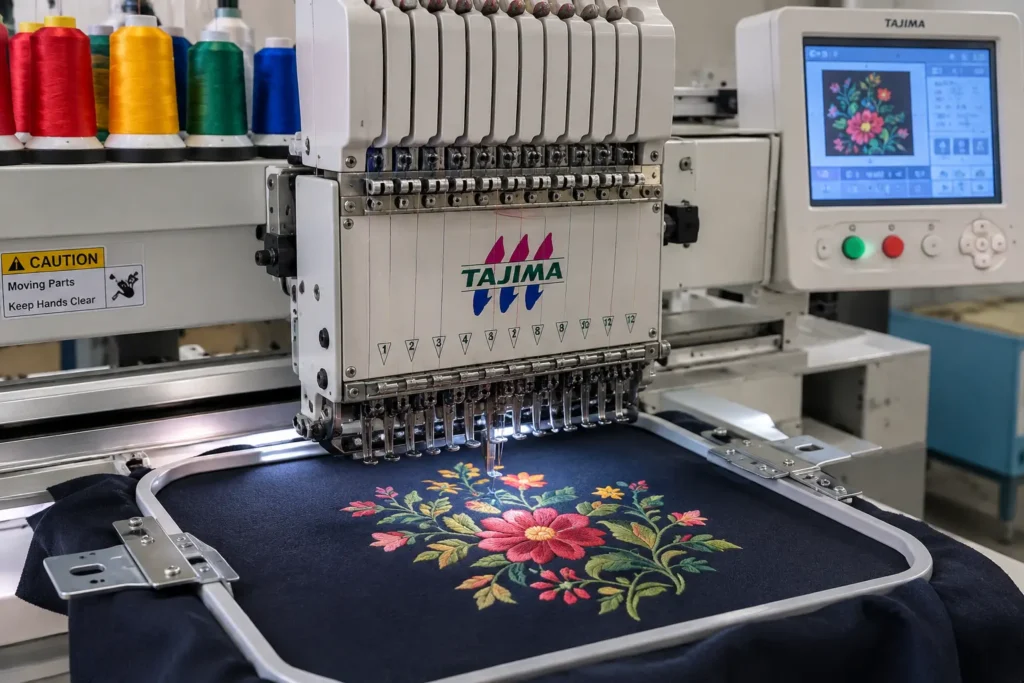

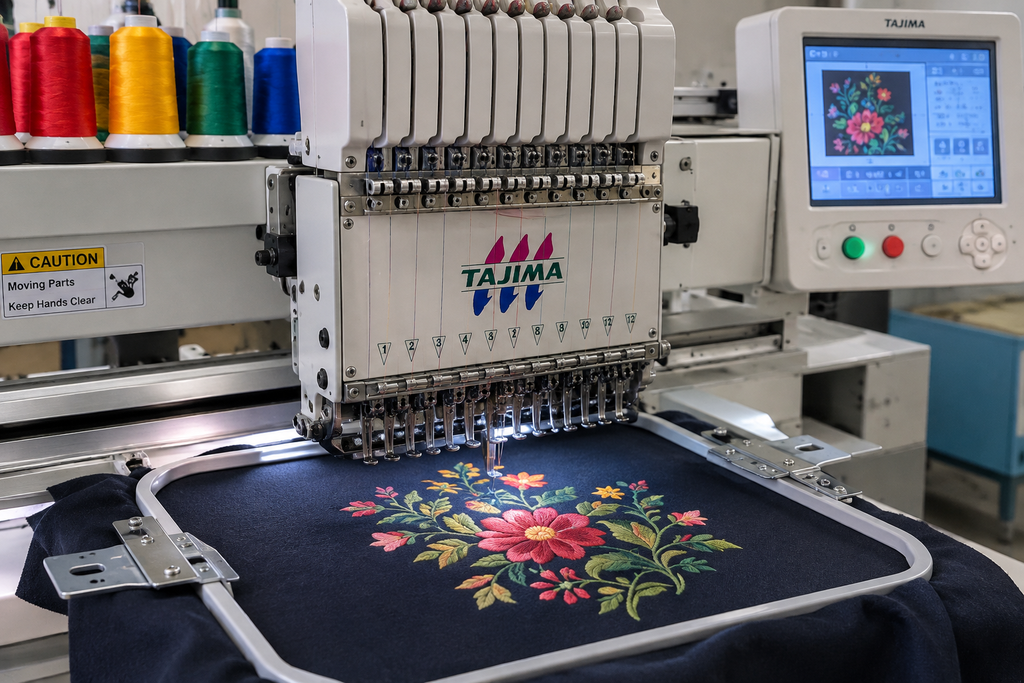
- Digital Design & Digitizing: Artwork or brand logos are converted via digitizing software into stitch files (e.g.,
.DST,.PES). These specify stitch types (satin, fill/tatami, running), needle direction, and automatic color change triggers. - Fabric Preparation & Hooping: Fabric or pre-cut garment panels are backed with non-woven stabilizers (tear-away, cut-away, or wash-away) to prevent stretch and puckering. They are mounted in rigid hoops or frames.
- Machine Setup & Alignment: The computerized control panel loads the digital file via network/USB. Operators map needle thread channels (usually 6 to 15 colors) to matching color steps in the software.
- Automated High-Speed Stitching: The machine moves the frame along precise horizontal ($X$) and vertical ($Y$) axes at speeds up to 1,000–1,200 stitches per minute. Automatic thread trimmers snip jump threads between distinct detail areas.
- Quality Check & Trimming: Completed panels undergo inspection for thread tension issues or thread breaks, excess backing is trimmed away, and pieces pass through a needle detector machine prior to assembly.
2. Core Machine Types Used in Production Lines
| Machine Type | Best Use Case | Key Features |
| Single-Head Commercial | Custom orders, samples, and hats | Single sewing station, 12–15 needles, highly versatile for variable products. |
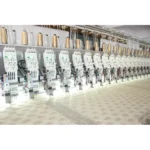
| Multi-Head Industrial | Mass garment production lines | 2 to 48 synchronized heads driven by a single pantograph rail; stitches identical patterns simultaneously. |
| Cap & Cylinder Embroidery | Curved products (baseball caps, sleeves) | Features a 270-degree rotating cylindrical driver instead of a flat frame system. |
| Schiffli Continuous Line | Broadcloth, lace, and continuous fabric bolts | Massive industrial looms with hundreds of needles working across wide continuous textile rolls. |
Production Workflow & Digitizing
1. What is the difference between image vectorizing and embroidery digitizing?
Vectorizing converts a raster image into smooth mathematical lines/paths (e.g., SVG, AI). Embroidery digitizing translates visual art into a machine-readable stitch path (.DST, .PES), specifying stitch counts, densities, stitch angles, push/pull compensation, and thread color stop commands.
2. Which stabilizer should be used for different fabric types?
- Cut-Away: Essential for knits, stretch, and performance wear (e.g., t-shirts, hoodies) to prevent stretch distortion during and after laundering.
- Tear-Away: Ideal for stable, non-stretch woven materials (e.g., twill jackets, caps, tote bags) where excess backing can easily be torn away cleanly.
- Wash-Away / Water-Soluble: Used as a top film (to prevent stitches from sinking into high-pile fabrics like fleece or towels) or as a temporary backing for sheer fabrics and lace.
3. What causes “bird’s nesting” (thread tangling) under the needle plate?
Bird’s nesting typically occurs when top thread tension is too loose, the upper thread path is misrouted (e.g., missed take-up lever), or the fabric bounces (“flagging”) inside an improperly hooped frame.
Machine Selection & Operations
4. When should a multi-head machine be chosen over single-head machines?
- Single-head commercial machines offer maximum flexibility for rapid setup, individual sample runs, variable names/monograms, and small orders.
- Multi-Head Industrial Lines (2 to 48 heads) are designed for high-volume, uniform production. All heads replicate the exact same design file simultaneously, reducing labor hours per garment.
5. What is the advantage of a 270-degree cap driver system?
Standard flat hoops only allow sewing on flat surfaces. A 270-degree cylindrical cap system rotates the curved cap frame beneath the needle bar, enabling continuous ear-to-ear stitching across the curved front and side panels of structured and unstructured hats.
6. How does speed affect production quality?
Industrial machines can run up to 1,000–1,200 stitches per minute (SPM). However, running at maximum speed on delicate fabrics, intricate detail work, or thick metallic threads increases thread breakage and puckering. Most commercial facilities run machines at 750–900 SPM for consistent quality control.